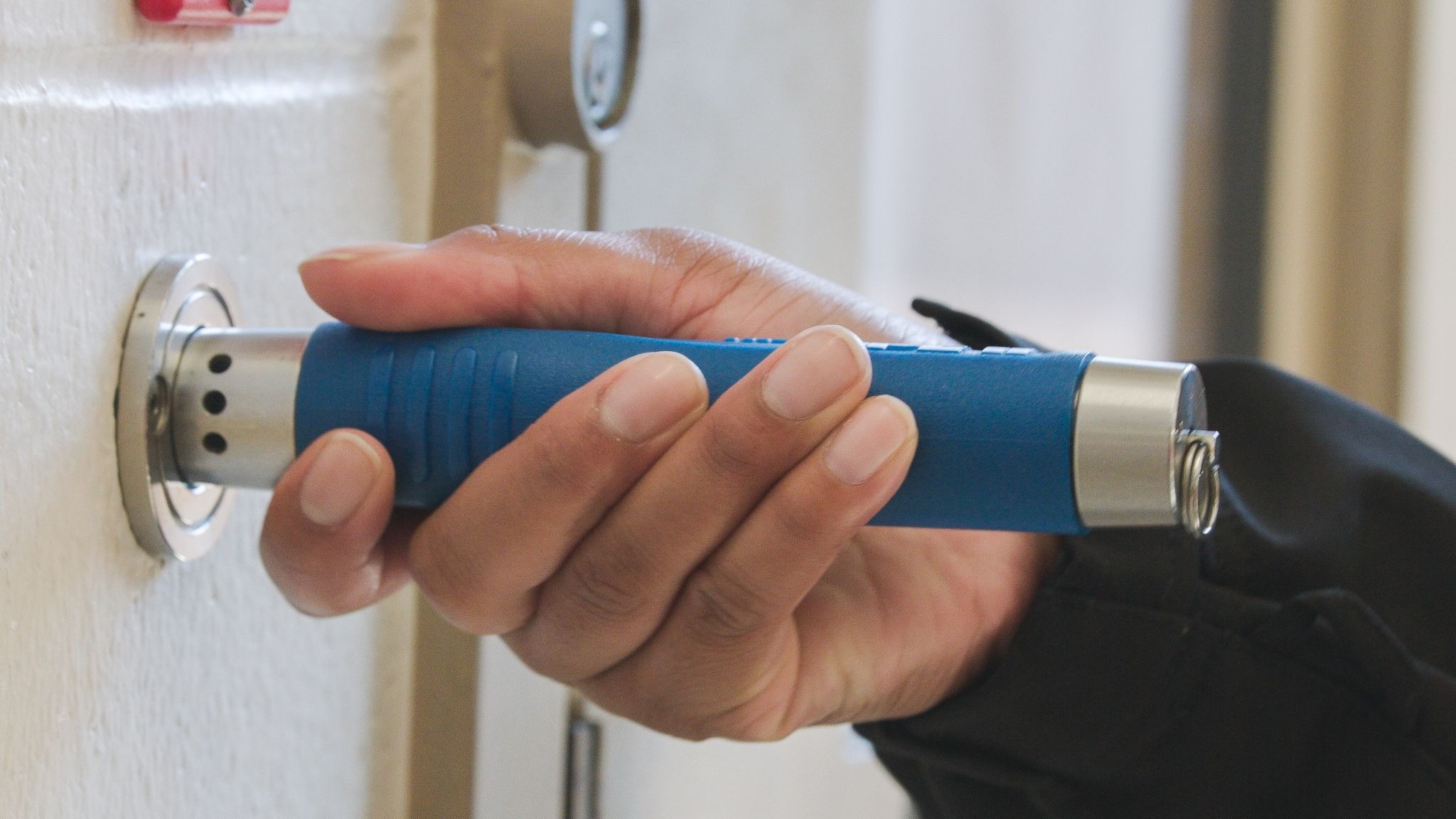
It's 3 a.m. A correctional officer is conducting rounds, tapping their guard tour wand to the wall, and moving on. Six hours later, that cell becomes the center of a wrongful-death lawsuit. And the only thing the guard tour system can confirm? That an officer physically checked in at the cell.
Not what they physically witnessed. Not if they saw any signs of life. Not whether the inmate was even breathing.
That missing layer of detail and accountability is why many agencies are rethinking traditional guard tour systems and evaluating a shift to officer experience platforms (OXPs).
This blog compares the two head-to-head: what each system is designed to do, associated costs, and why more agencies are making the switch.
What is a Guard Tour System?
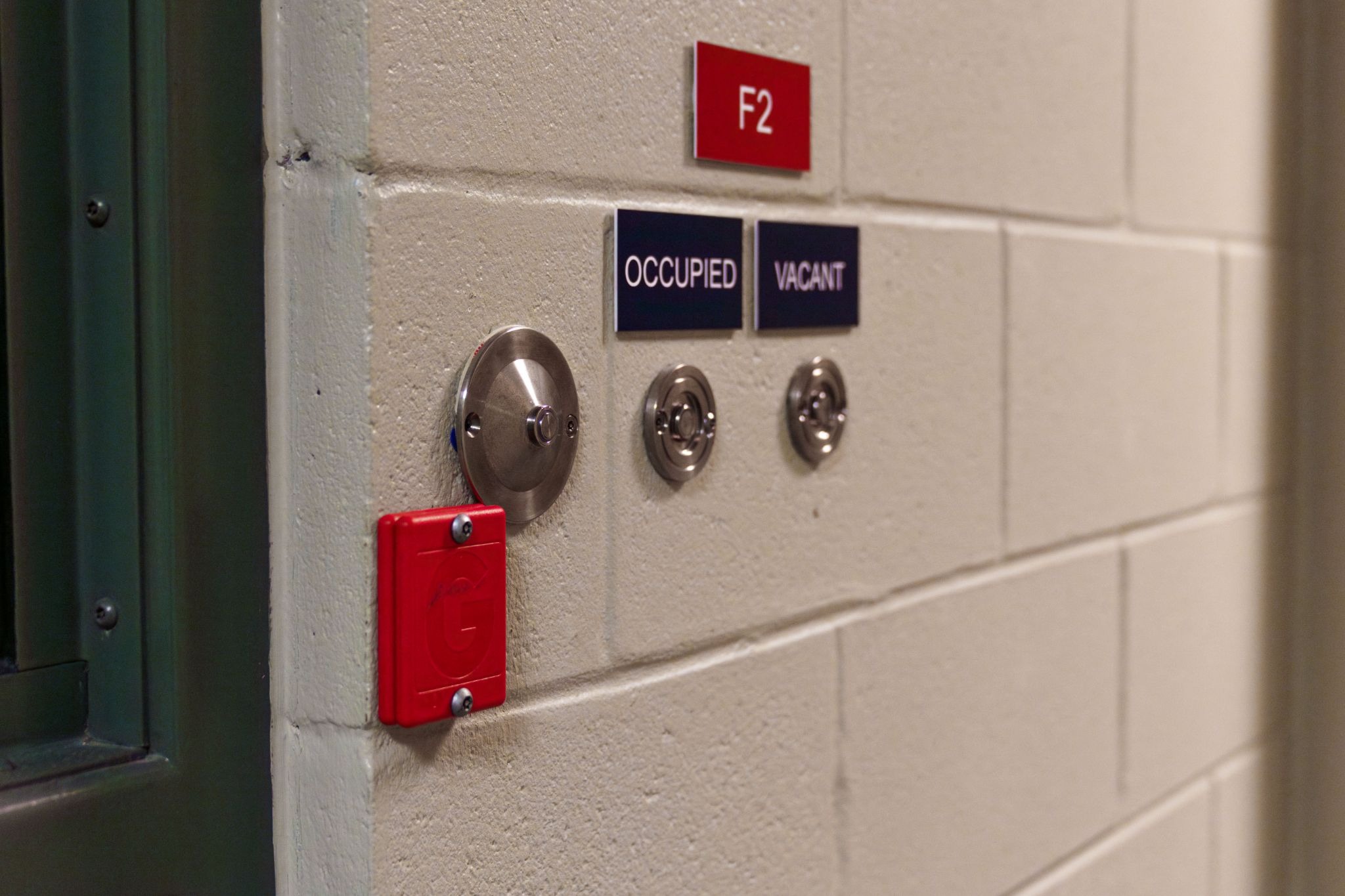
Guard tour systems are built to do one job: record that an officer scanned a fixed point at a fixed time. The officer touches a wand to a memory button or RFID contact mounted on the wall. The device logs that date, time, and location. That's it, that’s the feature set.
On paper, a guard tour's strengths include being:
- User-friendly: It takes one swift action to complete using its full capabilities
- Durable: Hardware is strong and difficult to break in a housing unit
- Affordable: Low unit cost on a purchase order
- Proven: Agencies have used wands for decades to document officer presence
It also has hard limitations. A guard tour wand can't:
- Capture a photo of contraband in a cell
- Record video of an individual in a restraint chair
- Customize a log of an inmate's mental state during a welfare check
- Document a med pass with a digital signature
- Alert an officer when the next round is due
- Track and update inmate movements for their rec time
- Push data to a supervisor's dashboard in real time
The trade-off is simple. A guard tour system is easy to use because it only does one thing. But "easy" is not the same as "enough." Most administrators are no longer satisfied with timestamps that just proves an officer was there.
Why Doesn't a Timestamp Hold Up?
When a death, escape, or lawsuit lands on the desk, a list of timestamps will not protect the agency. Why? Because a round timestamp answers only one question: did the officer reach the location? It does not answer:
- Was the inmate alive and breathing?
- Did the officer make face-to-face contact?
- Was contraband visible?
- Was the inmate in distress?
Plaintiffs' attorneys have learned to dismiss them as easily falsifiable. Officers who have walked rounds with a guard tour wand and a clipboard often describe the same blind spot.
Officer-In-Charge Conrad Dyer at the Adams County, Indiana Detention Center, said it plainly: “With the [legacy device], truthfully, you could have walked through the entire pod without looking at a single inmate.”
That is the heart of the problem. Single-function hardware does not capture the entirety of the round. In today's correctional environment, officers need a multi-function device that not only proves rounds happened but also documents what officers saw, heard, and did during them — not just a timestamp.
What is an Officer Experience Platform?
The officer experience platform (OXP) is a product category pioneered by GUARDIAN RFID. As the name suggests, the focus is the officer experience — designing technology around what officers actually do during a shift and what they need to perform effectively.
Rather than relying on disconnected tools, the OXP approach brings software, services, workflows, and operational support into a connected ecosystem designed to work together.
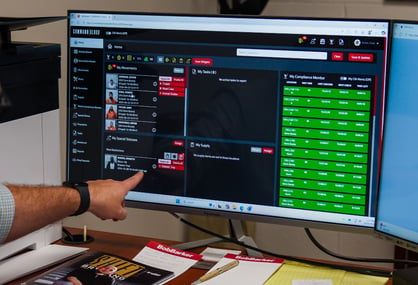
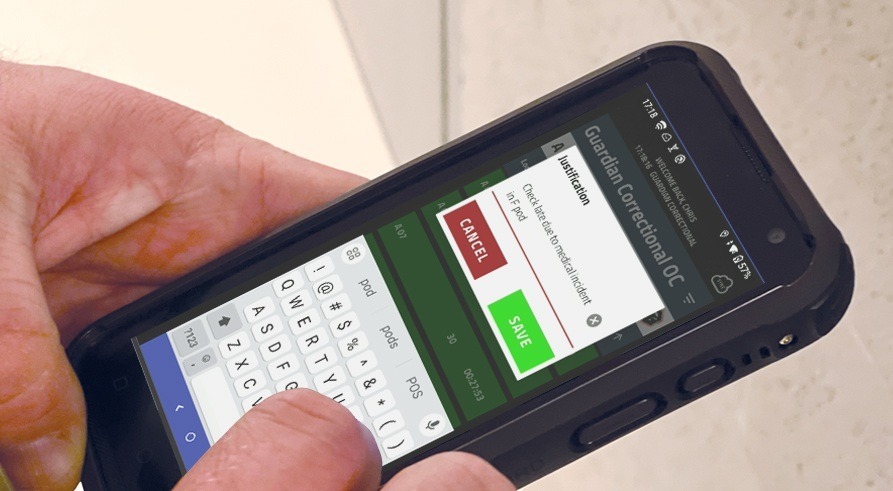
Command Cloud, developed by GUARDIAN RFID, is the first officer experience platform. It centralizes operational tools into a single system and gives agencies a real-time common operating picture — one live view of activity across the facility. That means faster and smarter decisions.
The point isn't a better wand. It's a platform that turns every action into a documented event. Command Cloud provides:
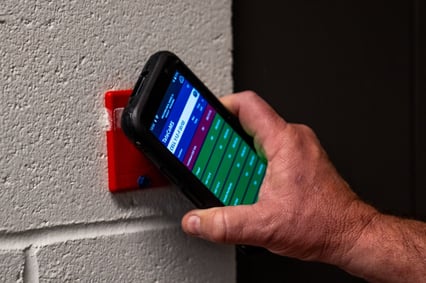
- One device for every data input: RFID scanning, digital evidence capture, and voice-to-text capabilities are all in a single rugged unit
- Digital evidence tied to the record: Photos and video evidence can be attached to the log the moment it was documented
- Built-in accountability: Audio and vibration alerts warn officers when a round is about to be due, and call out late rounds immediately
- A live operating picture: Supervisors can review all-around activity, incidents, and observations on a live, real-time dashboard
- Offline capabilities: Officers are empowered to operate in dead zones or in moments where Wi-Fi unexpectedly shuts down, as Command Cloud syncs automatically once connected back on Wi-Fi
- Connected integration: Swift communication between several jail management systems, ensuring data flows
So, when you compare the two methods head-to-head, what are the most obvious differences?
Guard Tour System vs. Officer Experience Platform
|
Capability |
Guard tour system |
Officer experience platform |
|---|---|---|
|
Round logging |
Timestamp + location |
Timestamp, location, photo, voice, and observation |
|
Scanning |
One fixed contact point |
RFID, NFC, and barcode |
|
Evidence capture |
None: no camera. |
Photo, video, voice at the point of responsibility |
|
Round accountability |
None: no alerts when rounds are late |
Audio and/or vibration alert before a round is due |
|
Incident documentation |
None: Device can’t capture manual documentation. |
Captures and routes detailed digital evidence on the spot |
|
Supervisor visibility |
Reports built off-device, hours later |
Real-time dashboard |
|
Connectivity |
Standalone |
Cloud-connected, syncs offline, integrates with JMS |
|
Court defensibility |
Timestamp only |
Time-stamped photo, video, signature, and voice |
The gap in capabilities speaks for itself.
At the Adams County Detention Center, staff found an inmate manufacturing hooch in his cell. With a wand, the discovery would have been documented later by hand. Instead, the officer captured photos and video on the spot using Command Cloud.
The evidence was uploaded to the cloud, tagged to the inmate, and routed to the disciplinary officer — before the cell door was even locked. “We click right on cell inspection,” said Adams County FTO Brad Schuler. “If they have contraband or anything that shouldn't belong in their cell, staff can take pictures and videos of it, and it gets uploaded right to the cloud.”
That is the difference between proving a round occurred and proving what the officer saw during it.
Adams County Sheriff Dan Mawhorr summarized the leap his agency took from legacy hardware to a multi-function platform in one sentence: “Looking at the technology, we went from just a 'rod' to a 'mini computer.' It makes a big difference.”
What Would Upgrading to an OXP Cost My Agency?
Let’s get to the meat of what you’re likely wondering: What is this upgrade going to cost me?
On a unit-cost spreadsheet, most guard tour systems are going to be more affordable than OXPs. But that depends on how you do the math.
Most guard tour systems carry hidden costs. While it looks cheap on the purchase order, it’s important to think about how much larger an expense it will become over time. Consider the realities that come with guard tour systems:
- Replacement costs: Worn-out memory buttons and broken wands add up year after year
- Litigation exposure: A timestamp doesn't always defend in court
- Wasted hours: Reports built off the guard tour wands get cross-referenced against paper logs by hand before every jail inspection
- Lost evidence: Anything the officer saw that the guard tour wand can't record is hearsay
That's where the real math lives. Standards bodies, such as the American Correctional Association (ACA), increasingly judge the quality of a record, not just the timestamp on it. And the stakes are unforgiving — one missed observation can become a multi-million-dollar lawsuit.
Sheriff Dan Mawhorr framed his investment this way: “Command Cloud safeguards my people from complaints, and it's saving me a lot of litigation. To me, that's worth the investment right there.”
Frequently Asked Questions
Can an OXP still perform guard tour rounds?
Yes. Round logging is one feature of the platform, not a separate tool you bolt on. An OXP records the same time, location, and point-of-contact a wand does — then adds the photo, video, voice note, and observation the wand never could. You don't give up guard tour functionality. You absorb it into something larger.
Can a guard tour system meet ACA or state jail standards?
A guard tour system can document that rounds occurred, which satisfies the baseline under most state jail standards. But the bar is moving. The American Correctional Association (ACA) increasingly evaluates the quality of a record, not just the timestamp on it. An OXP gives agencies a fuller, defensible record to bring to audits and accreditation reviews.
Does an OXP work without facility-wide Wi-Fi?
Yes. A quality OXP operates offline in dead zones and during unexpected outages, then syncs automatically once it reconnects. A facility doesn't need 100% coverage to deploy one. Reliable Wi-Fi in housing units, booking, and intake should be the baseline, not full-building saturation.
Is an OXP worth the higher unit cost?
The device costs more up front. The total cost of ownership often doesn't. An OXP cuts the hidden costs a wand racks up over a decade — replacement hardware, paper-log reconciliation hours, and lost evidence — and reduces the litigation exposure a timestamp can't defend. Once risk is priced in, the math favors the platform.
What's the difference between a timestamp and court-defensible documentation?
A timestamp proves an officer reached a location. It can't prove what they saw, whether contact was made, or whether the individual was in distress, which is why plaintiffs' attorneys dismiss timestamps as easily falsifiable. Court-defensible documentation pairs the time and location with photo, video, and voice evidence captured at the point of responsibility. One proves a round happened. The other proves what happened during it.
The Bottom Line
A guard tour system and an OXP aren't two versions of the same tool. One proves a round happened. The other proves what happened during it.
The question for agencies is no longer whether a guard tour wand can log a round. It's whether a wand can prove anything else — face-to-face contact, signs of distress, contraband on the floor.
In a profession where one missed observation can become a multi-million-dollar lawsuit, the device in an officer's hand should do more than count steps. It should document what officers see, hear, and do, and stand up when that record is challenged.
Adams County made that leap — from a "rod" to a platform — and cut its litigation exposure in the process. The same shift is on the table for your facility.
Ready to see what a modern officer's device actually does on shift?